

Kimi K3: What Moonshot’s 2.8T Open Frontier Model Actually Ships
Moonshot AI launched Kimi K3 as a 2.8-trillion-parameter model with native vision and a 1-million-token context window. You can use it today on Kimi.com, Kimi Work, Kimi Code, and the Kimi API; full weights are scheduled for July 27, 2026.
What shipped
Moonshot calls K3 the first open 3T-class model and its most capable release to date. On Moonshot’s own evaluation suite, K3 trails Claude Fable 5 and GPT 5.6 Sol at the top of the stack while beating the other models Moonshot tested. Treat that ranking as vendor-reported until independent runs land with the weights.
Spec | Kimi K3 |
|---|---|
Total parameters | 2.8 trillion |
MoE routing | 16 of 896 experts active (Stable LatentMoE) |
Attention | Kimi Delta Attention (KDA) + Attention Residuals (AttnRes) |
Context | 1,000,000 tokens |
Modalities | Native text + vision (images and video in product demos) |
Reasoning at launch | Max thinking effort by default |
Access today | kimi.com, Kimi Work ≥3.1.0, Kimi Code, API |
Weights | Promised by July 27, 2026 |
[!NOTE] “Open” currently means open access through Moonshot products and API, plus a public weight release date. Until July 27, you cannot download or inspect the checkpoint yourself.
Low- and high-effort thinking modes are planned for later updates. At launch, plan for max-effort latency and output cost on every call.
Architecture in plain terms
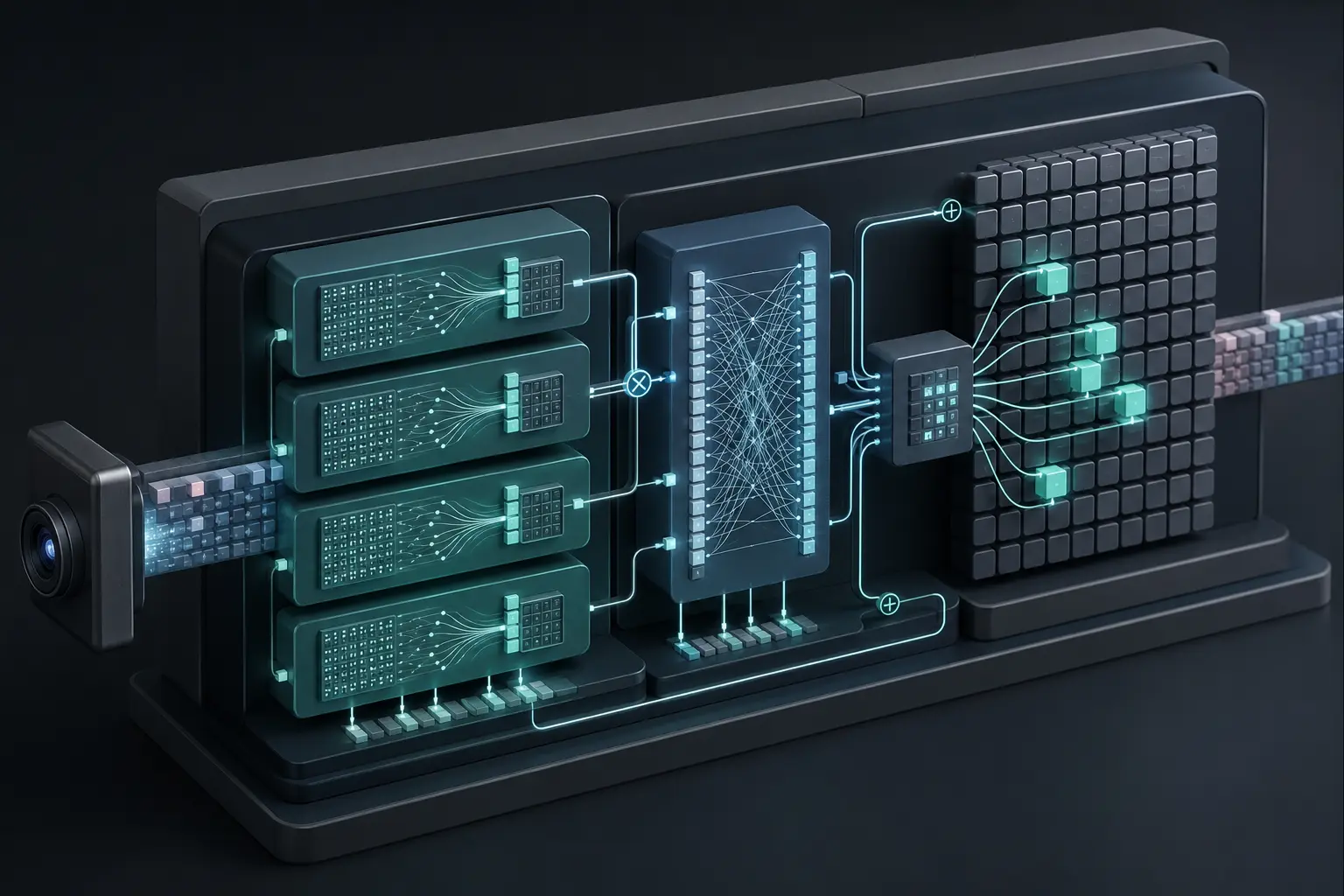
K3 scales sparse MoE further than earlier Kimi models and changes how information moves across sequence length and depth. Moonshot reports roughly 2.5× better overall scaling efficiency versus Kimi K2 from the combined architecture and training recipe changes.
KDA targets long-sequence attention cost so a million-token window stays practical at decode time. AttnRes lets later blocks pull selected representations from earlier depth instead of stacking residuals the same way at every layer. Stable LatentMoE keeps training stable at extreme sparsity: Quantile Balancing allocates experts from router-score quantiles, and Per-Head Muon adapts optimizer steps per attention head. Moonshot also names SiTU activations and Gated MLA as part of the stack.
Training uses quantization-aware SFT with MXFP4 weights and MXFP8 activations. For self-hosting after weights land, Moonshot recommends supernode deployments with 64 or more accelerators, and it plans to ship a KDA-aware prefix-cache path into vLLM alongside the release.
Where it shows up in practice
Long-horizon coding
Moonshot positions K3 for multi-hour engineering sessions: large repos, terminal tools, and vision-in-the-loop work on frontend, game, and CAD tasks where the agent reads live screenshots and revises code.
One vendor case study stands out for end-to-end systems work. K3 built MiniTriton, a compact Triton-like GPU compiler with a tile-level IR over MLIR, optimization passes, and PTX codegen. Moonshot reports roofline results on par with or better than Triton and torch.compile on supported workloads, plus stable nanoGPT training through the full pipeline. That is a stronger claim than “wrote a kernel”: it is DSL → IR → codegen → runtime.
Other Moonshot demos include 24-hour GPU kernel optimization sandboxes (competitive with Fable 5 under their protocol), a 48-hour chip design run on Nangate 45nm that closed timing at 100 MHz inside 4 mm², and a computational-astrophysics reproduction that reviewed 20+ papers and shipped 3,000+ lines of Python plus an interactive dashboard in about two hours. Treat these as curated demos, not guaranteed production SLAs.
Knowledge work and Kimi Work
On internal knowledge-work benches built from real agent workflows, Moonshot reports consistent gains for K3 at max effort. Product examples in Kimi Work include multi-round industry research sites with charts and interactive visuals, fusion-industry consulting packs, and a GWTC-5 gravitational-wave analysis across hundreds of events with concurrent subagents.
Kimi Work also adds Widgets and Dashboard: interactive components inside chat that can bind to local data or plugins, then pin into a persistent topic- or project-level view.
Multimodal creation
Because vision sits in the same model rather than a bolted-on adapter story, Moonshot shows motion-graphics explainers and video editing workflows. One demo edited a teaser from 56 source clips with motion-matched cuts and beat sync. Useful signal if your workload mixes screenshots, slides, and short video; less relevant if you only need text completion.
Who should try K3 first
Start with K3 if you already run agentic coding or research loops that burn long context and benefit from screenshot feedback. Skip it as your default chat model if you need polished everyday UX today; Moonshot itself says Fable 5 and GPT 5.6 Sol still feel better in that lane. Teams that care about self-hosting should treat the July 27 weight drop as the real decision point, not the API launch.
Access and pricing
Channel | How to get K3 |
|---|---|
Consumer | kimi.com or the Kimi mobile apps (iOS, Android, HarmonyOS) |
Desktop agents | Kimi Work 3.1.0+ on Windows and Apple silicon Macs |
Terminal coding | Kimi Code, then |
API | Model ID |
Teams | Kimi Enterprise (separate org accounts, member management) |
Official API pricing (per million tokens):
Token type | Price |
|---|---|
Cache-hit input | $0.30 |
Cache-miss input | $3.00 |
Output (includes reasoning tokens) | $15.00 |
Pricing is flat across the 1M context window. Moonshot serves K3 through Mooncake’s disaggregated inference stack and reports cache-hit rates above 90% on coding workloads when prefixes stay stable. At a 90% hit rate, blended input cost sits near $0.57/MTok; your rate depends on how often the prompt prefix changes.
[!TIP] Keep system prompts, tool schemas, and large repo context as a stable prefix. Context caching is automatic; a new request can hit the prefix cache only when the previous request’s prompt tokens exceed 256.
[!WARNING] Output at $15/MTok dominates cost when max thinking stays on. Budget for long agent loops before you paste a million-token corpus.
Rough math: ten agent turns that each emit 4K reasoning-plus-answer tokens cost about $0.60 in output alone, before input. Keep tool traces and intermediate plans short when you can; K3 will happily keep thinking if you leave the loop unconstrained.
How to read the benchmarks
Moonshot’s published K3 scores use reasoning effort max, temperature 1.0, and top-p 1.0. Agent benchmarks run under KimiCode, Claude Code, or Codex depending on the task, so cross-model tables mix harnesses. Footnotes also flag hardware recalibrations (for example SWE Marathon on an H20-calibrated branch) and cases where competitor trajectories include fallbacks. Compare numbers only after you match harness, effort, and hardware notes.
A few public anchors from their footnotes:
DeepSWE v1.1: 67.3 under the mini-SWE-agent harness on the official leaderboard path they cite
BrowseComp: 90.4 with the full 1M window and no context compaction (compaction-triggered runs use a different protocol)
Moonshot states overall performance still trails Fable 5 and GPT 5.6 Sol while beating other tested models. Independent Artificial Analysis and third-party harness results will matter more after weights and a shared eval setup exist. Until then, use the table as a directional map: strong coding and agentic knowledge work relative to open peers, with a known UX gap versus the two proprietary leaders Moonshot names.
If you run your own bake-off, freeze the harness first. Switching tools mid-comparison will swamp any model delta, and K3’s thinking-history requirement makes harness choice part of the result.
Limitations that change how you run it
Thinking history. K3 trains on preserved thinking history. If your harness drops prior thinking tokens, or you mid-session switch from another model to K3, quality can become unstable. Prefer a verified harness such as Kimi Code, and start a fresh session for K3.
Over-proactive agents. Long-horizon training makes K3 invent next steps when intent is fuzzy. For bounded ops work, pin explicit constraints in the system prompt or
AGENTS.md.UX gap. Moonshot acknowledges a noticeable product-experience gap versus Claude Fable 5 and GPT 5.6 Sol even when raw capability is competitive.
Self-host reality. A 2.8T sparse MoE with KDA needs serious interconnect and a KDA-aware serving stack. Calendar the July 27 weight drop; do not plan local deploys on API-only assumptions.
What to do next
Pick one path this week: run a long-context coding task through Kimi Code with /model set to Kimi K3 and inspect cache-hit vs miss tokens on the API, or put July 27, 2026 on the calendar and prepare a vLLM/supernode checklist for when the weights and technical report land.
Comments
0No comments yet. Be the first to share your thoughts!